
Description
What Is a Short Cam Walker Boot?
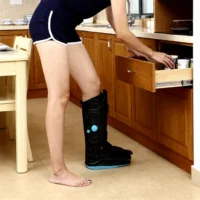
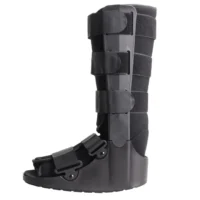
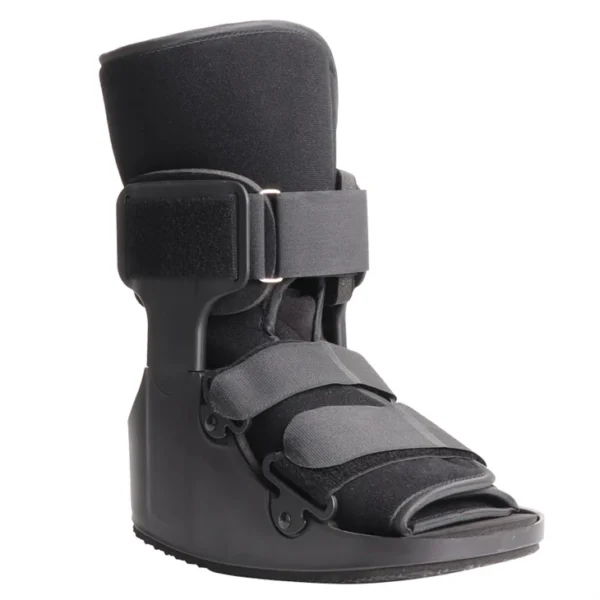
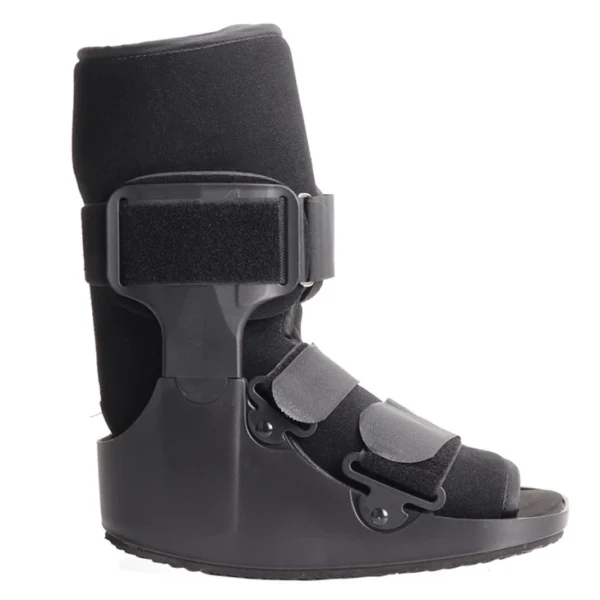
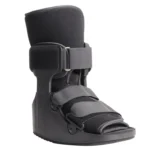
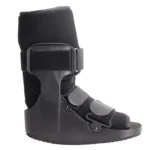
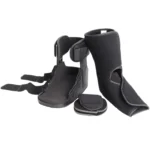
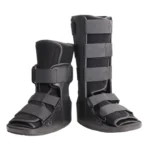
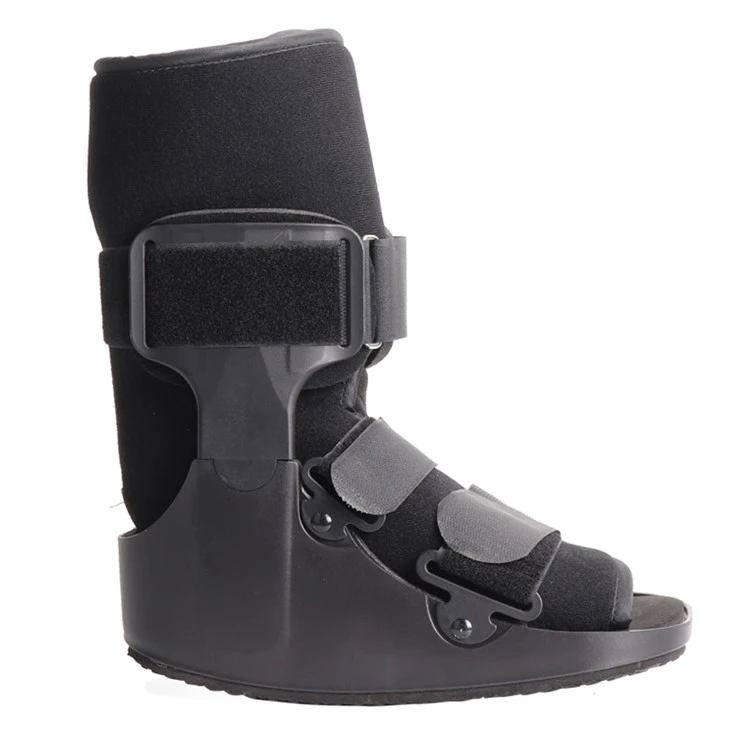
A short cam walker boot is a fixed-shell walking boot with no hinge: the frame holds the ankle in one position and the rocker sole carries the foot through each step. It is the simplest kind of protection and the closest replacement for a cast, which is why it is often the boot issued straight after an injury or a procedure. Model WK-006 is an 11-inch short cam walker boot with a reinforced shell, dual straps with a metal buckle and an open-toe design, in sizes XS to XL. It has no angle adjustment and no air cushion.
Why Choose This Cam Walker Boot?
Stays put. So you can forget it’s there. That sentence is the design brief behind this short cam walker boot, and it matters most in a fixed shell, because there is no strap adjustment left to hide a poor fit once the frame is on. An analysis of 1,058 knee-brace reviews and community threads found the most common complaint was a support that slides down while you walk (109 mentions), followed by heat and itching (77), over-tightening and pressure on the calf (65) and unreliable sizing (64).
Four design decisions answer those complaints directly.
- Reinforced Outer Shell: A high-strength plastic and composite frame wraps the ankle and foot, limiting abnormal joint movement and reducing the chance of a second injury while the first one heals.
- Dual Straps with Metal Buckles: Two straps closed by metal hardware adapt to different foot shapes and hold the foot against the shell, which is what keeps a short cam walker boot stable on uneven ground.
- Open-Toe Design: Leaving the toes exposed allows circulation to be checked easily, permits some toe movement, and relieves pressure during long wear.
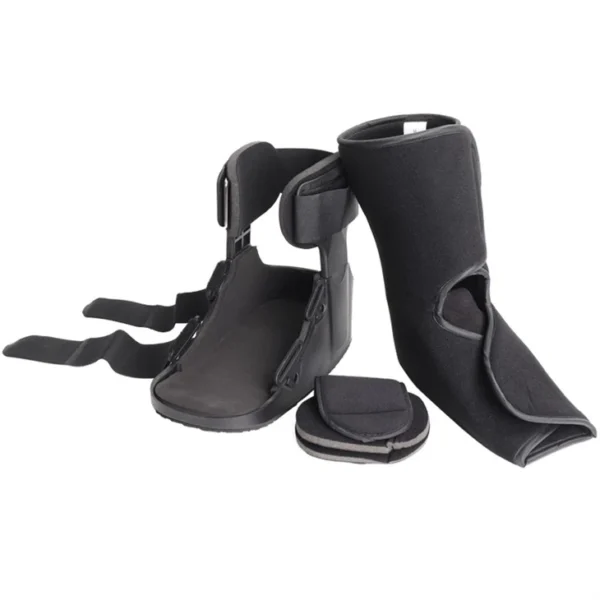
- Lace-Free Slip-On Fit: Nothing to tie: the boot goes on and comes off with the straps alone, which matters for anyone whose movement is restricted or who is recovering from surgery.
Premium Engineering & Design Details
Every value below applies to model WK-006, the 11-inch short cam walker boot in this listing.
Strategic Advantage Over Standard Walking Cast Boots
Compared with a standard walking cast boot, four structural differences matter most.
- Removable, So the Limb Can Be Checked: A cast cannot be opened. This short cam walker boot comes off for skin checks, cleaning and imaging, and goes back on with the same two straps.
- Strap Fit Instead of Plaster: Two straps with metal buckles adapt to the shape of the foot, which is more forgiving when swelling is still changing.
- An Open Toe: Toes stay visible, so circulation can be assessed at a glance and pressure is relieved at the front of the foot.
- Built to Be Worn Outside: The water-resistant, abrasion-resistant fabric and the reinforced shell are intended for real use on pavements, not only indoors.
Two honest limitations. First, this is a fixed shell: there is no hinge and no angle setting, so if your protocol calls for controlled movement, a ROM boot is the correct choice. Second, a short cam walker boot protects the limb but does not set your weight-bearing limit — that instruction comes from your clinician, and it should be followed exactly.
OEM and ODM programmes are available for distributors and private-label brands, including logo, packaging and specification development.
Best For: Foot & Ankle Fracture Recovery
This short cam walker boot is intended for the situations below.
- Post-surgical immobilisation, as a replacement for a conventional cast after foot or ankle procedures
- Acute injury management, including severe sprains and ligament tears that need limited joint movement
- Chronic condition support, providing sustained stability for flat arches and tendonitis
- Follow-up appointments and imaging, where the limb has to be accessible
- Use at home and outdoors during the weeks between appointments
- Clinic and distributor programmes that need a cast alternative across a wide size range, with a short cam walker boot in five sizes
The American Academy of Orthopaedic Surgeons (AAOS) patient information on ankle fractures explains that a nondisplaced medial malleolus fracture can be treated with a short leg cast or walking boot, that a nondisplaced lateral malleolus fracture can often be treated the same way, and that many isolated lateral malleolus fractures are stable enough to allow weight-bearing. It also notes that most ankle fractures take at least six weeks for early healing and ten to twelve weeks for complete healing.
Browse the full range of walker boots, or see our short walking boot if you want the same 11-inch height with an inflatable air cushion.
Sizing & Fitting Guide (11″ Short Height)
This short cam walker boot is an 11-inch shell in five sizes, and it fits either foot.
Fitting in three steps: seat the heel at the back of the shell with the toes clear of the open front; close the lower strap first and then the upper strap so the foot cannot slide forward; then check that you can still feel your toes and that no single spot is taking pressure.
Regulate strap tightness as your medical professional directs, so that circulation is not restricted. Allow a gradual adjustment period during the first days of wear, and check the straps and buckles periodically for signs of wear so the shell keeps giving maximum support.
Frequently Asked Questions (FAQ)
What is a short cam walker boot used for? It holds the ankle and foot in one position while an injury or a procedure heals, and it is commonly used as a replacement for a conventional cast. A short cam walker boot is the right choice when the joint must not move.
Does it have a hinge or angle settings? No. This is a fixed-shell design: the frame holds the ankle in one position. If your clinician wants controlled movement in set increments, choose a ROM boot instead.
Is there an air cushion? No. This model relies on the reinforced shell, the cushioned lining and the two straps. If air compression is part of your treatment plan, choose a pneumatic boot.
Can I walk outside in it? Yes. The outer fabric is water and abrasion resistant and the shell is reinforced, so this short cam walker boot is intended for outdoor use. Take care on wet or uneven ground and follow your weight-bearing instructions.
How tight should the straps be? Firm enough that the foot cannot slide forward, loose enough that circulation is not restricted. Check the toes after fitting and again after ten minutes of walking, and have the tightness regulated as your clinician directs.
How long will I need it? That depends on your injury. The AAOS notes that most ankle fractures take at least six weeks for early healing and ten to twelve weeks for complete healing, and your own schedule will be set around follow-up imaging.
Medical Disclaimer
This product is intended for general orthopedic stabilization and support purposes only. It does not constitute personalized medical advice. Always consult your primary healthcare provider, orthopedic specialist, or physical therapist to ensure this device is appropriate for your specific injury, rehabilitation schedule, and weight-bearing status before use.