Buying and sizing guidance for orthopedic braces and supports.
1. The Ultimate Orthopedic Brace Sizing Guide for B2B Buyers
Getting the right fit and technical specification is essential for clinical efficacy, patient comfort, and customer satisfaction. The orthopedic brace sizing guide provided by Reluky helps global distributors, medical importers, and healthcare providers streamline their procurement process.
Accurate sizing directly reduces product return rates and prevents post-operative complications caused by improper joint restraint. For official clinical standards on joint immobilization, you can refer to the AAOS Clinical Practice Guidelines for evidence-based orthopaedic care.
2. Step-by-Step Girth & Measurement Instructions
To ensure precise ordering across our Orthopedic Support Products, follow these standard measurement protocols for each body region:
- Knee Brace Circumference: Measure 15 cm (6 inches) above the midpoint of the patella (thigh circumference) and 12 cm below the patella (calf circumference) while the leg is extended.
- Walker Boot Sizing: Select boot sizes (S, M, L, XL) based on international shoe size conversion charts rather than overall height alone. Check our Walker Boots Collection for rigid shell height details (11-inch vs. 17-inch).
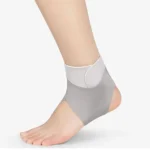
- Ankle & Foot Orthoses: Measure the circumference around the heel and instep using a flexible measuring tape. Explore our specialized Ankle & Foot Braces for nighttime splinting options.
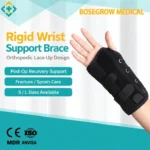
- Wrist & Upper Limb Supports: Measure wrist circumference at the narrowest point proximal to the wrist joint before selecting models from our Upper Limb Braces.
For a broader understanding of human anatomical measurement standards, review the comprehensive guide on Anatomical Landmarks on PubMed.
3. How to Choose Between Support Levels: Soft vs. Rigid
When sourcing from our catalog, using a reliable orthopedic brace sizing guide alongside the correct support level ensures your inventory aligns with target clinical needs, regional compliance standards, and market demand:
A. Soft Elastic & Neoprene Sleeves (Mild Support)
- Primary Function: Provides mild joint compression, localized warmth, and gentle proprioceptive feedback to enhance stability during daily activities.
- Key Features & Construction: Anatomical 3D-knit weaving, breathable neoprene linings, hexagonal ventilation patterns, and open-patella silicone gel pads for patellar tracking.
- Target Clinical Indications: Grade 1 mild joint sprains, chronic arthritis management, daily patellar tendinitis support, and preventive sports protection.
- Sizing & B2B Spec Notes: Refer to our orthopedic brace sizing guide for proper thigh and calf circumference checks. Ideal for high-volume retail, e-commerce brands, and mixed-container starter orders.
B. Semi-Rigid Supports with Stays (Moderate Support)
- Primary Function: Delivers structural medial and lateral stabilization while retaining functional mobility for sub-acute recovery phases.
- Key Features & Construction: Flexible dual-sided spiral steel stays, contoured aluminum side bars, adjustable criss-cross compression straps, and heavy-duty hook-and-loop closures.
- Target Clinical Indications: Moderate ligament strains, meniscus tears, collateral ligament sprains, and post-cast immobilization step-down care.
- Sizing & B2B Spec Notes: High demand among orthopedic clinics and medical supply distributors. Accurate sizing parameters are outlined in our orthopedic brace sizing guide to support custom strap adjustments and private-label box designs.
C. Rigid ROM Hinged Orthoses (Maximum Immobilization)
Sizing & B2B Spec Notes: Clinical-grade orthoses required by hospital supply tenders. Always follow our technical orthopedic brace sizing guide to confirm limb length and girth before bulk ordering.
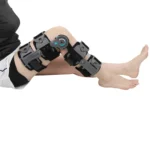
Primary Function: Offers strict mechanical range-of-motion (ROM) limitation and rigid structural immobilization for major joint rehabilitation.
Key Features & Construction: Precision dial-lock bilateral hinges, telescopic extension bars (19″ to 24″), tool-free angle setting (-10° to 120°), and plush high-density non-slip breathable liners.
Target Clinical Indications: Post-operative ACL, MCL, and PCL reconstruction, severe patellar dislocation, tibial plateau fractures, and acute surgical rehabilitation.
4. Key Considerations for Using an Orthopedic Brace Sizing Guide
When ordering pneumatic or rigid CAM walking boots, utilizing a professional orthopedic brace sizing guide is the first line of defense against clinical fitting errors. Before final procurement approval, ensure your sizing guide for orthopedic braces aligns with the following 4 critical technical specifications:
- Inflatable Air Bladders: Dual-chamber air pumps provide custom compression around swelling ankles. (Note: Always check the orthopedic brace sizing guide matrix to ensure the bladder placement matches the patient’s calf circumference).
- Rocker Sole Profile: Ergonomic low-profile soles encourage a natural gait during post-op recovery.
- Liner Material: Removable, washable high-density foam or plush linings for extended patient compliance.
- Custom Labeling: Ensure private label packaging and barcode tags meet local medical device regulations.
5. Frequently Asked Questions on Sizing & OEM Specs
Are your orthopedic braces sized by European or US standards?
Our standard sizing tables accommodate universal dimensional ranges covering XS to 5XL. Detailed sizing charts are published on every individual product page.
How do we request technical drawings for custom sizing?
Where dimensional data is not fully disclosed on the product page, our engineering team provides technical production drawings upon request via our Contact Page prior to bulk sampling.
Can custom brand logos be added to sizing labels?
Yes, we provide full OEM and ODM customization. You can Request a Quote to discuss custom-printed outer boxes, sewn-in size tags, and multilingual instruction sheets.