
Description
What Is a Knee Immobilizer?
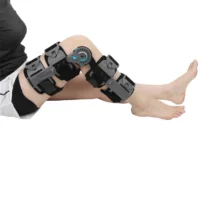
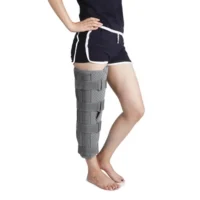
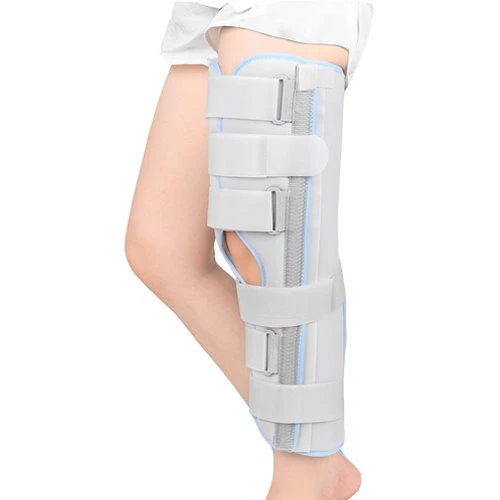
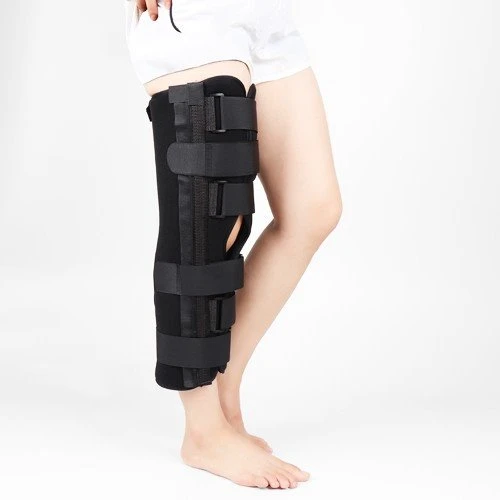
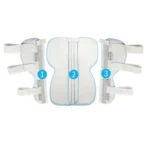
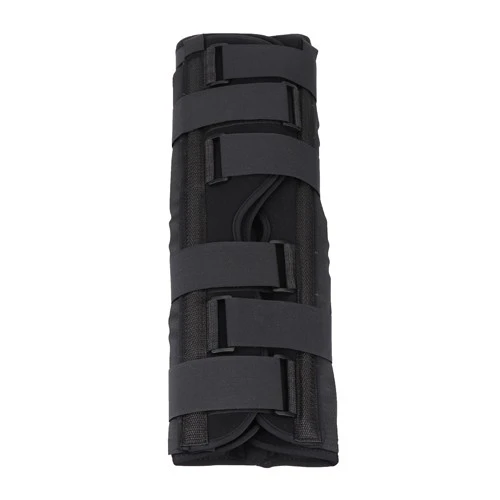
A knee immobilizer is a full-leg brace that holds the knee in one fixed position so the joint cannot bend while an injury or a surgical repair heals. Unlike a hinged support, it does not offer adjustable movement: it keeps the leg straight by design. Model KN-025 is a tri-panel immobilizer with shape-following aluminium stays, multiple straps and a split design that can be taken apart without blocking X-ray views. It is not a hinged range-of-motion brace, and it is not a knee sleeve.
Why Choose This Tri-Panel Full Leg Brace?
Stays put. So you can forget it’s there. That sentence is the design brief behind this brace, and it matters most for a knee immobilizer, because these braces are worn through the day and often through the night for several weeks.
An analysis of 1,058 knee-brace reviews and community threads found the most common complaint was a support that slides down while you walk (109 mentions), followed by heat and itching (77), over-tightening and pressure on the calf (65) and unreliable sizing (64). A full-leg brace that migrates is worse than useless: it moves the knee it is meant to hold still.
Four design decisions answer those complaints directly.
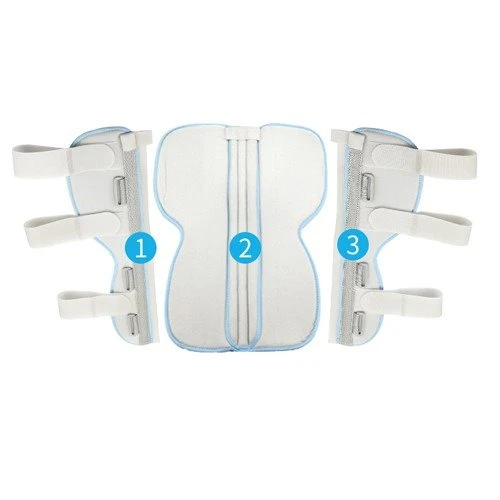
- Tri-Panel Full Leg Structure: A back panel and two side panels wrap the leg from thigh to calf, so the joint is supported along its whole length rather than at a single point.
- Shape-Following Aluminium Stays: Curved stays behind the leg and straight stays along the sides give the shell its shape and hold the knee in the position it was set to.
- Multiple Straps and Wraps: An open design closed by four nylon straps, with four to six hook-and-loop wraps around the leg to stop the shell rotating or slipping.
- Perforated Breathable Fabric with Padded Lining: Round punched fabric over a soft sponge and towel lining lets air through, which is what makes a knee immobilizer wearable for weeks.
Premium Engineering & Design Details
Every value below applies to model KN-025, the tri-panel knee immobilizer in this listing.
Strategic Advantage Over Standard Knee Immobilizers
Compared with a standard knee immobilizer, four structural differences matter most.
- Three Panels Instead of One Flat Splint: A single flat splint has to be strapped tight to stay on. A tri-panel knee immobilizer distributes contact over the back and both sides, so it holds position with less pressure in any one spot.
- Imaging Without Removal: The split design can be opened and recombined around an X-ray view, which means the leg does not have to be repositioned and the brace does not have to be refitted from scratch at every follow-up.
- Breathable by Construction: Round punched fabric and a padded lining matter more in an immobilizer than in a support, because this brace is worn for weeks and often overnight.
- Fastening That Stays Put: Four nylon straps plus four to six wraps and a D-ring closure hold the shell against the leg through walking on crutches and transfers in and out of bed.
Two honest limitations. First, a knee immobilizer keeps the knee straight, and the AAOS notes that long periods of immobilization can leave the knee stiff and the thigh muscles weak, so rehabilitation exercises matter as soon as your clinician allows them. Second, this brace is not adjustable in angle: if your protocol needs progressive movement, a hinged brace is the right product instead.
OEM and ODM programmes are available for distributors and private-label brands, including logo, packaging and specification development.
Indications: Secure Knee Fixation & Post-Operative Support
This knee immobilizer is intended for the clinical situations below.
- Secure knee fixation, where the joint must be held straight while bone or soft tissue heals
- Post-operative protection after knee surgery, when movement is not yet permitted
- Patellar fracture and other knee fracture management, where the leg is kept extended during healing
- Support during the weight-bearing stage, when a clinician allows full weight through a leg held straight
- Post-injury fixation and transport, where the knee needs to be stabilized before further assessment
- Use in hospital, clinic and home settings, including overnight wear
The American Academy of Orthopaedic Surgeons (AAOS) patient information on patellar (kneecap) fractures explains that a cast or splint may be applied to keep the knee straight and prevent motion in the leg while the bone heals, that patients are often able to put full weight on the knee in a knee immobilizer or a brace locked in extension, that the knee generally needs to stay straight for two to four weeks, and that immobilization over a long period can make the knee stiff and the thigh muscles weak.
Browse the full range of knee braces, or see our adjustable knee immobilizer if some controlled angle adjustment is needed.
Sizing & Fitting Guide (12″–22″, XS–XL)
This knee immobilizer is available in six lengths from 12 inches to 22 inches, mapped to sizes XS through XL, and it fits either leg.
Fitting in three steps: choose the length that runs from mid-thigh to the calf without pressing behind the knee; place the shell with the back panel centred behind the joint and the side panels resting flat; then close the nylon straps from the top down, add a wrap above and below the knee, and check that the brace cannot rotate when you walk.
Re-check the straps every time the brace goes back on. A knee immobilizer that is even slightly loose will ride down the leg, and the two sponge pads supplied with the brace are the first thing to use if the shell feels loose on a smaller limb.
Frequently Asked Questions (FAQ)
What is a knee immobilizer used for? It holds the knee straight so the joint cannot bend while a fracture, a repair or an acute injury heals. The AAOS describes patients putting full weight on the knee in a knee immobilizer or a brace locked in extension, usually with the knee kept straight for two to four weeks.
How is a knee immobilizer different from a hinged knee brace? A hinged brace allows controlled movement and adjustable limits. A knee immobilizer holds one position. If your clinician wants controlled movement, a hinged product is the correct choice; if the requirement is fixation, this is the correct choice.
How long do I wear it each day? Follow the schedule you are given, which commonly includes overnight wear while the leg is protected. The AAOS notes that long periods of immobilization can leave the knee stiff and the thigh muscles weak, so begin the exercises your clinician prescribes as soon as you are allowed.
How do I choose between the six lengths? Use the length that runs from mid-thigh to the calf with the back panel behind the joint and no pressure in the hollow behind the knee. If you are between lengths, plan the fit around your limb length rather than your height; extra sponge pads are supplied to fine-tune the fit.
Can I keep it on for an X-ray? The shell can be split and recombined without affecting front or side X-ray fluoroscopy, so imaging can be done with the brace in place and the leg still supported.
Will a knee immobilizer make my muscles weaker? Yes, if it is worn for a long time without exercise, and the AAOS states this plainly. A knee immobilizer protects the joint; it does not replace rehabilitation. Keep to the exercise programme your clinician gives you, and expect the brace to be removed as soon as your protocol allows.
Medical Disclaimer
This product is intended for general orthopedic stabilization and support purposes only. It does not constitute personalized medical advice. Always consult your primary healthcare provider, orthopedic specialist, or physical therapist to ensure this device is appropriate for your specific injury, rehabilitation schedule, and weight-bearing status before use.