
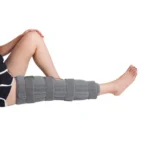
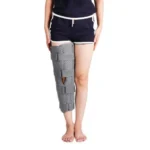
Description
What Is an Adjustable Knee Immobilizer?
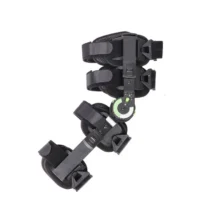
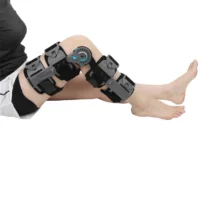
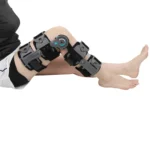
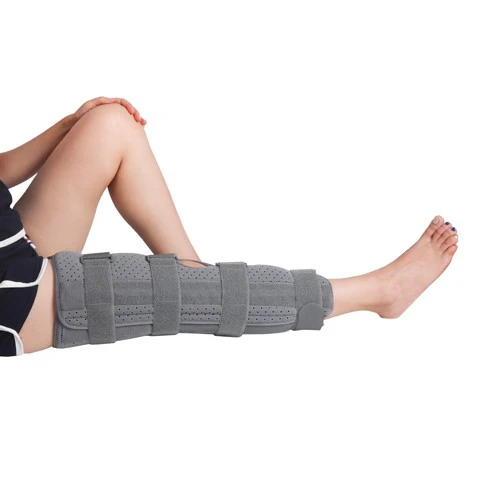
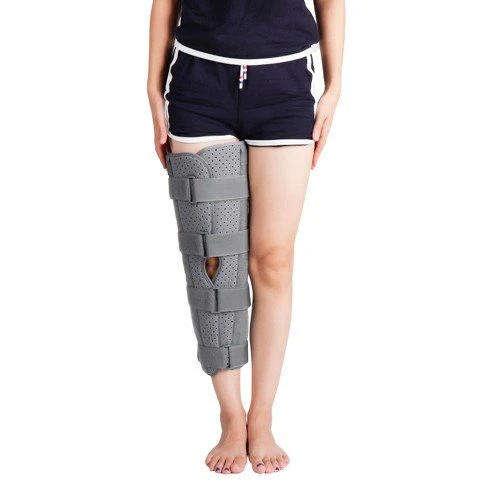
An adjustable knee immobilizer is a fixation brace that holds the knee still, but unlike a fixed splint it lets the clinician choose the angle the joint is held at. Model KN-026 uses a precision gear mechanism with an adjustable range from −10° to 120°, so the same brace can lock the knee straight in the first days after surgery and hold it at a prescribed angle later. It is a fixation device: it is not a hinged range-of-motion brace, and it is not a knee sleeve.
Why Choose This Adjustable Knee Fixation Brace?
Stays put. So you can forget it’s there. That sentence is the design brief behind this brace, and it matters most for an adjustable knee immobilizer, because a fixation brace is worn for hours at a time and often overnight. An analysis of 1,058 knee-brace reviews and community threads found the most common complaint was a support that slides down while you walk (109 mentions), followed by heat and itching (77), over-tightening and pressure on the calf (65) and unreliable sizing (64).
Four design decisions answer those complaints directly.
- Precision Gear Angle Setting: The angle is set by a geared mechanism with a wide −10° to 120° range, used either to hold the joint still or to allow a permitted position, and reset in clinic without tools.
- Non-Slip Protective Cotton Lining: A cotton contact layer is chosen to be kind to the skin; the manufacturer states that even wearers with sensitive or allergy-prone skin can wear it without irritation.
- Added Anti-Slip Straps: Dedicated anti-slip straps are fitted to stop an adjustable knee immobilizer from falling down the leg when you walk, which is the failure mode that makes people loosen a brace until it does nothing.
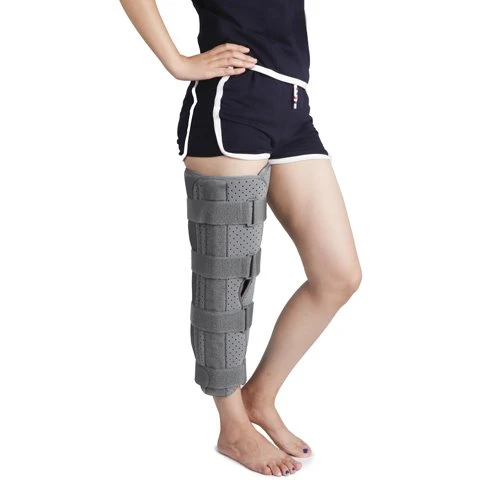
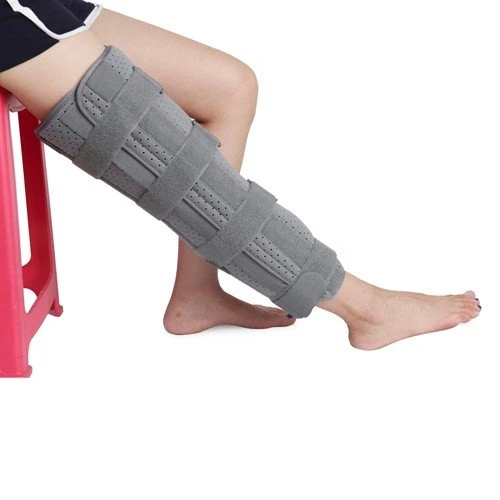
- Multiple Hook-and-Loop Straps: Several straps close the shell against the leg, for a firmer hold than a traditional two-strap fixation brace.
Premium Engineering & Design Details
Every value below applies to model KN-026, the adjustable knee immobilizer in this listing.

Strategic Advantage Over Standard Knee Immobilizers
Compared with a standard knee immobilizer, four structural differences matter most.
- An Angle You Can Set, Not a Position You Are Stuck With: A fixed splint holds one position only, so it becomes obsolete as the protocol changes. This adjustable knee immobilizer covers −10° to 120°, which means one device follows the whole fixation period.
- Built to Stay on a Walking Leg: Anti-slip straps and a non-slip cotton lining work together against the sliding that forces people to over-tighten a brace, and over-tightening is what causes the pressure and itching people complain about most.
- Comfort Instead of Bulk: The modern comfort build avoids the heavy, hot construction of traditional braces, which matters when the brace is on for most of the day and all night.
- Length That Adjusts to the Limb: Free length adjustment with a uni size keeps the shell aligned with the joint, which is what prevents the brace from pushing into the calf.
Two honest limitations. First, this is still a fixation device: if your protocol calls for progressive movement through a hinge, a hinged brace is the correct product. Second, no brace replaces rehabilitation, and the AAOS notes that knee function and strength are restored by continuing exercises for several weeks after surgery.
OEM and ODM programmes are available for distributors and private-label brands, including colour customisation, logo, packaging and specification development.
Indications: Knee Fixation & Controlled Angle Setting
This adjustable knee immobilizer is intended for the clinical situations below.
- Knee fixation after surgery, where the joint must be held in a set position while a repair heals
- Post-operative support where a permitted angle is prescribed rather than full immobilization
- Fixation after injury, including transport and the period before a treatment decision is made
- Use as an alternative to plaster-style rigid fixation, where the treating clinician agrees a removable brace is appropriate
- Walking support during recovery, where the brace has to stay in position while the patient moves
- Hospital, clinic and home use, including overnight wear, with the settings of the adjustable knee immobilizer confirmed by the treating clinician
The American Academy of Orthopaedic Surgeons (AAOS) patient information on knee arthroscopy notes that most knee arthroscopy procedures are performed as outpatient surgery, that braces are sometimes used after the procedure when a repair or reconstruction must be protected, and that rehabilitation exercise should continue regularly for several weeks after surgery to restore motion and strength.
Browse the full range of knee braces, or see our knee immobilizer for the tri-panel full-leg fixation option used when a joint is held in one position.
Sizing & Fitting Guide (Uni Size, Freely Adjustable Length)
This adjustable knee immobilizer is a uni-size brace with freely adjustable length, so it is sized on the leg rather than ordered in a size.
Fitting in three steps: set the shell length so the brace runs from the thigh to the calf without pressing behind the knee; set the gear angle to the value your clinician has given you; then close the straps from the top down, add the anti-slip straps last, and check that the brace cannot rotate when you walk.
Check the angle after the brace has been on for a while. An adjustable knee immobilizer that has been knocked out of position during a transfer will hold the knee at the wrong angle, and the anti-slip straps are there to prevent exactly that.
Frequently Asked Questions (FAQ)
What is an adjustable knee immobilizer used for? It holds the knee in a chosen position while a repair or an injury heals, and it lets the clinician change that position without changing the device. The gear setting covers −10° to 120°, so it is used for fixation and for prescribed-angle support.
How is it different from a knee immobilizer with no angle adjustment? A fixed immobilizer holds one position. An adjustable knee immobilizer can be locked at the angle your surgeon specifies, then reset as the protocol changes, which usually removes the need for a second device later.
Is it comfortable enough to wear at night? The non-slip protective cotton lining and the lighter comfort build are designed for long wear, which is what lets an adjustable knee immobilizer stay on overnight; the manufacturer states the lining is suitable for sensitive or allergy-prone skin. Follow the wear schedule you are given, including overnight wear if it is required.
Will it stay in place when I walk? Dedicated anti-slip straps and the non-slip lining are fitted for that purpose, so an adjustable knee immobilizer does not slide down while you walk, and multiple hook-and-loop straps give a firmer hold than a traditional fixation brace. Re-check the straps after the first ten minutes of walking.
Does one size really fit most people? The brace is uni size with freely adjustable length, so it is fitted to the limb on the leg. If your leg length or circumference falls outside the adjustment range, contact us before ordering.
Will a brace make my knee weaker? A brace protects the joint; it does not replace rehabilitation. The AAOS notes that exercise should continue regularly for several weeks after knee surgery to restore motion and strength, so keep to your programme and use this adjustable knee immobilizer only as your clinician directs.
Medical Disclaimer
This product is intended for general orthopedic stabilization and support purposes only. It does not constitute personalized medical advice. Always consult your primary healthcare provider, orthopedic specialist, or physical therapist to ensure this device is appropriate for your specific injury, rehabilitation schedule, and weight-bearing status before use.