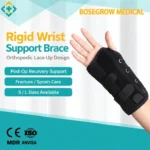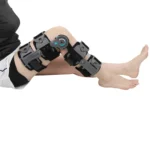

An ankle foot orthosis is not the same product as an ankle brace. The two sit side by side in most catalogues and are routinely confused in purchase orders, but they are built differently, priced differently and sold to different parts of your customer base.
This guide is for importers, distributors, pharmacies, clinic buyers and cross-border sellers who need to specify, sample and stock ankle foot orthoses. It is a sourcing and selection guide only: clinical decisions, including which design a given end user should wear, belong to the clinician or prescriber in your market.
What separates an orthosis from an ankle brace
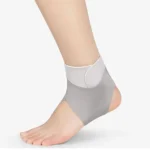
An ankle brace wraps the ankle joint. It is soft or semi-rigid — knit, neoprene or a bonded laminate — and it is sized by ankle circumference. Figure-of-eight straps, lace-up panels and compression sleeves all belong to that family.
An ankle foot orthosis adds a foot plate beneath the sole and a proximal section that extends up the lower leg. That combination is what allows the product to hold the ankle and foot at a controlled angle rather than only compressing the joint. Add those two elements and the item becomes a different product: different tooling, different material consumption, different packing, different price band.
They are not interchangeable stock lines for a distributor.
The construction types you will meet in a catalogue
Catalogues group these products into five construction families, and the names are used loosely across the industry. Confirm the build, not the label.
| Construction | How it is built | What changes for the buyer |
|---|---|---|
| Solid shell | One-piece rigid shell, moulded foot plate, trim line above the ankle; no joint | Fewest components and usually the lowest unit cost, with no joint to test for wear |
| Hinged | Two shell sections joined by a mechanical ankle joint | Adds joint hardware and assembly time; check stiffness and stop retention at sampling |
| Posterior leaf spring | Thin flexible strut behind the calf, bonded to a foot plate | Light and low profile; strut thickness is the quality variable and is easy to under-specify |
| Dynamic / carbon composite | Energy-storing carbon strut with a rigid foot plate | Highest material cost; ask for ply lay-up and thickness, not just the word “carbon” |
| Static night design | Fixed-angle shell or soft boot with a rigid foot section, worn without a shoe | Simple and inexpensive, but sized on a different scale from shoe-worn models |
What actually drives the unit price
These products look similar in photographs yet quote across a wide range. The variables below move the number.
| Cost driver | Entry level | Higher end | The question to ask |
|---|---|---|---|
| Shell material and thickness | Single-layer polypropylene, 2.5–3 mm | Copolymer or carbon composite, 3–4 mm | Which grade, and what wall thickness at the malleolus? |
| Construction | Solid shell, no joint | Hinged or dynamic strut | Is the joint metal or polymer, and is it replaceable? |
| Trim finishing | Hand-cut, raw edge | Die-cut, rolled or padded edge | Is the finish consistent batch to batch? |
| Padding and liner | Bare shell | Foam-lined or fabric-covered | What foam density, and does it stay bonded after washing? |
| Straps and closures | Two hook-and-loop straps | Three or four padded straps | How many open-and-close cycles is the closure rated for? |
| Side-specific tooling | Universal left/right | Separate left and right lasts | Universal halves your SKU count — is it available here? |
| Heat-mouldable | No | Yes, with a stated moulding range | What is the moulding temperature window? |
| Packaging and private label | Bulk polybag, stock colour | Retail box, barcode, custom colour and logo | What tooling cost and minimum variant quantity? |
The first two rows carry most of the unit cost, so fix them before comparing quotations. On a 2,000-piece order, whether the trim is hand-cut and polished or die-cut and edge-rolled often separates two quotes that look identical on paper.
How size runs are usually specified
Shoe-size sizing
One size code covers a range of men’s and women’s shoe sizes. Retail and pharmacy buyers prefer this format because it matches how their customers already think about fit.
Foot-length sizing
A centimetre measurement of the foot. It is more precise, and it is the format most clinics ask for, because it does not depend on a shoe-size convention that differs between markets.
Insist on receiving both. A chart showing only US shoe sizes is unusable in the EU, the UK and Japan, and the conversion is not linear. Mismatched size mapping is the most common source of returns in this category.
| Field | Typical format | Why it matters |
|---|---|---|
| Size code | S / M / L / XL or numeric | Determines your SKU count |
| Men’s and women’s shoe size | Ranges, e.g. 6.5–10 and 8–11.5 | Retail-facing mapping |
| Foot length | Centimetres | Clinic-facing mapping |
| Side | Left, right or universal | Universal halves your SKU count |
| Proximal circumference | Centimetres | Decides whether the shell closes on larger calves |
| Weight guidance | Only if the facility publishes it | If it is not published, do not print one on your own packaging |
Confirm a universal, left/right interchangeable design on the technical drawing rather than from a catalogue photo. It genuinely halves the size run, but it is only available on certain constructions.
What belongs in your RFQ
A complete enquiry covers ten points, and sending all ten at once typically removes two or three rounds of correspondence: construction and material; size run and preferred chart format; side, or universal; straps, padding and closure; colour, logo and private label; retail packaging and barcode; destination port; target landed cost; indicative annual volume; and the documents you need before shipping.
Minimum order quantity, sampling lead time and bulk production lead time are quoted per project rather than published as site-wide numbers, because they move with material, tooling and finishing method. Ask for all three in writing, and ask whether sample costs are credited against the bulk order, before you commit to a launch date. Our procurement FAQ explains how those figures are confirmed, and the wider orthopaedic range shows which product families can usually share a container with an orthosis order.
Documentation that travels with the goods
Certificates and test reports belong to the facility that produced the item. They are not transferable general claims, and they are not the same thing as a website statement. Before shipping, confirm four things: the issuing body, the exact models covered, the validity period, and that the model numbers on the document match your purchase order. Documentation is matched per ordered item, and nothing on a supplier’s website — including this one — constitutes a blanket statement of approval by any regulatory authority.
Settle the instruction-for-use leaflet early, including who approves the translated text.
Frequently asked questions
What is the difference between an ankle foot orthosis and an ankle brace? An ankle brace wraps and supports the ankle joint and is sized by ankle circumference. An orthosis adds a foot plate under the sole and a section extending above the ankle, which holds the ankle and foot at a controlled angle. Different tooling, different price band, not interchangeable.
How are ankle foot orthosis sizes specified? Either by shoe size, mapped to men’s and women’s ranges, or by foot length in centimetres. Ask for both on one chart. US, EU, UK and Japanese conversions are not linear, and mismatched mapping is the most common cause of returns.
Can ankle foot orthoses be private-labelled? Yes. Colour, trim, strap colour, foam density, logo label and retail packaging can all be specified. Tooling cost, minimum variant quantity and prototype lead time are quoted per project, so fix the design before asking for the price.
Are the orthoses supplied with certificates? Certificates and test reports belong to the producing facility. Before shipping we verify the issuing body, the models covered and the validity period against your purchase order, so you receive a matched document set rather than a generic scan.
What is the minimum order quantity? It depends on construction, material and degree of customisation, and is confirmed individually in your quotation. A stock-colour solid shell and a bespoke carbon model do not carry the same minimum.
Where to start
If you already know the construction and size run you need, send the specification and we will return a costed quotation. If you are still narrowing the range, review the ankle and foot brace range alongside the toe-to-knee designs before committing, because the two tiers are stocked and priced differently. You can also read how we work with buyers or request a quotation with your target volume and destination market.