
“How to choose a knee brace” is usually asked by an end user, but the same question decides a distributor’s stock plan. Get the family mix wrong and you carry expensive inventory that does not move; get the size run wrong and you generate returns in a category where fit is the whole product.
This guide is for importers, distributors, pharmacies, clinic buyers and cross-border sellers who need to specify, sample and stock knee braces. It works through the four product families, the hinge hardware that drives most of the price, the measurements a size run should be built on, and the fields for a request for quotation. It is a sourcing guide only: which design suits a particular end user is a clinical decision for the clinician or prescriber in your market.
The four families you will be quoting
Most knee brace catalogues resolve into four families. They differ in how much structure they add and how much adjustment they allow, and that difference explains almost the entire price spread.
| Family | How it is built | Stock and price logic | What to check at sampling |
|---|---|---|---|
| Compression sleeve | One-piece knit or neoprene tube, no straps, no hardware | Lowest unit cost, but fit-dependent, so it needs the deepest size run | Knit recovery after washing, seam position, whether the top edge rolls |
| Wrap-around support | Open-backed panel with hook-and-loop straps, sometimes with flexible stays | Fewer SKUs because straps absorb size overlap | Strap anchoring, foam bonding, whether the stays are removable |
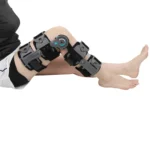
| Hinged brace | Rigid frame, mechanical hinge, usually bilateral side stays, straightens or limits range | Highest hardware content and the widest price spread in the family | Hinge stiffness, stop retention, padding between hardware and liner |
| Immobilizer | Rigid straight shell with straps, dial-lock or fixed, minimal articulation | Simple construction, low SKU count, bulky cartons | Shell rigidity, dial lock action, liner compression over a full day |
A practical starting mix for a new market: a deep size run of the sleeve, a mid-depth run of the wrap-around, and narrow coverage of the two rigid families, widening the rigid lines once you have demand data.
Hinges: what the buyer is actually paying for
On a hinged brace, most of the unit cost sits in hardware, and hardware is also where quality failures surface fastest. Four questions settle it.
Is the hinge single-axis or polycentric?
A polycentric hinge uses a geared pair of pivots, costs more and needs tighter tolerances — so ask whether the joint is metal or polymer, and whether it is replaceable.
Are the range stops pins, a dial or interchangeable inserts?
Each fails differently: pins can be lost, dials can slip, inserts can be fitted the wrong way round. Get the angle range and step interval in writing.
How many side stays, and how much padding?
Stay count and stiffness are easy to under-specify, and they separate two braces that look alike in a photograph. Padding between hardware and liner is the first thing to get cheaper when a quotation comes in low — and the first thing an end user notices.
Sizing: circumference is the specification that matters
Knee braces are sized by circumference, not by height or by trouser size. Get the measurement points right at the specification stage and the size run almost builds itself.
| Field | Typical measurement point | Why it matters |
|---|---|---|
| Size code | S / M / L / XL or numeric | Sets your SKU count |
| Mid-patella circumference | Around the knee, at the kneecap | The primary fit dimension |
| Thigh circumference | Stated distance above the knee, usually 15 cm | Decides whether the upper strap closes properly |
| Calf circumference | Stated distance below the knee | Decides whether the lower strap closes properly |
| Leg length | For long-frame braces only | Keeps the frame from sitting in the wrong place |
| Side | Universal, or left and right | Universal halves the size run |
Two rules save money here. The distance above and below the knee must be written on the chart — “thigh circumference” without a measurement point is unusable. And flexible wrap-around designs carry fewer SKUs than sleeves, because the straps absorb the overlap between sizes, so the sleeve line needs the deepest run. Plan quantities accordingly rather than applying one depth across the range.
Materials and comfort variables that drive returns
Strap count and width are the most under-specified part of a knee brace. A four-strap design is not automatically better than a three-strap one — it distributes load differently and costs more to assemble — but two straps on a longer frame will migrate during movement, and migration is the most common reason a brace comes back.
Beyond straps, check four materials variables: whether the liner is neoprene, knit or a bonded laminate; whether it is perforated, because a non-breathable liner is a summer complaint; whether there is a silicone or textured anti-slip band at the top edge; and whether the knee section is open or closed, since an open design changes both the pattern and the size tolerance.
What belongs in your RFQ
Include the family and frame type, the hinge type and angle range if fitted, the stay count, the number and width of straps, the liner material and whether it is breathable, the measurement points for the size chart, side or universal, colour, logo and private-label requirements, retail packaging and barcode details, destination port, target landed cost and indicative annual volume.
Minimum order quantity, sampling lead time and bulk production lead time are quoted per project rather than published as site-wide numbers, because they move with material, tooling and finishing. Ask for all three in writing, and ask whether sample costs are credited against the bulk order, before you commit to a launch date. Our procurement FAQ explains how those figures are confirmed.
Packaging and documents
Rigid frames are bulky and sensitive to carton crush, so agree carton quantity, folded dimensions and inner packing before production, and specify whether each brace ships in a printed retail box or a bulk polybag. If it carries a retail box, decide early who owns the artwork and who approves the proof.
Certificates and test reports belong to the facility that produced the item. Confirm the issuing body, the models covered and the validity period, and check that the model numbers match your purchase order — documentation is matched per item, and nothing on a supplier’s website is a blanket approval statement by any regulatory authority. For soft goods, fix the washing and care wording at the same time; it is printed on the insert, not added later.
Frequently asked questions
What types of knee brace are there? Four families are used commercially: one-piece compression sleeves, wrap-around supports with adjustable straps, hinged braces with a rigid frame and mechanical joint, and rigid straight-shell immobilizers. They differ in structure, adjustment and price, and are stocked as separate lines rather than variants of one product.
How do I measure for a knee brace size run? Measure the mid-patella circumference around the knee, plus thigh and calf circumference at a stated distance above and below the knee. Ask the supplier to publish those distances on the chart. For long-frame braces, add a leg-length dimension.
What is the difference between a hinged knee brace and a knee sleeve? A sleeve is a one-piece knit tube that adds compression and no hardware, so it depends entirely on correct sizing. A hinged brace adds a rigid frame, a mechanical joint and usually bilateral side stays, which raises the hardware content, the assembly time and the price.
Can knee braces be private-labelled? Yes. Frame colour, strap colour, liner material, logo label, retail box artwork and barcode can all be specified. Tooling or set-up cost, minimum variant quantity and prototype lead time are quoted per project, so settle the design before requesting the price.
What is the minimum order quantity? It depends on the family, material and degree of customisation, and is confirmed individually in your quotation. A stock-colour sleeve and a bespoke hinged frame do not carry the same minimum.
Where to start
If you know the family mix and the measurement points, send the specification and we will return a costed quotation. If you are still deciding which families deserve the deepest size run, review the knee brace range and the wider orthopaedic range before you commit. You can also read how we work with buyers or request a quotation with your target volume and destination market.